How Live-Service Games Are Changing the Player-Developer Relationship
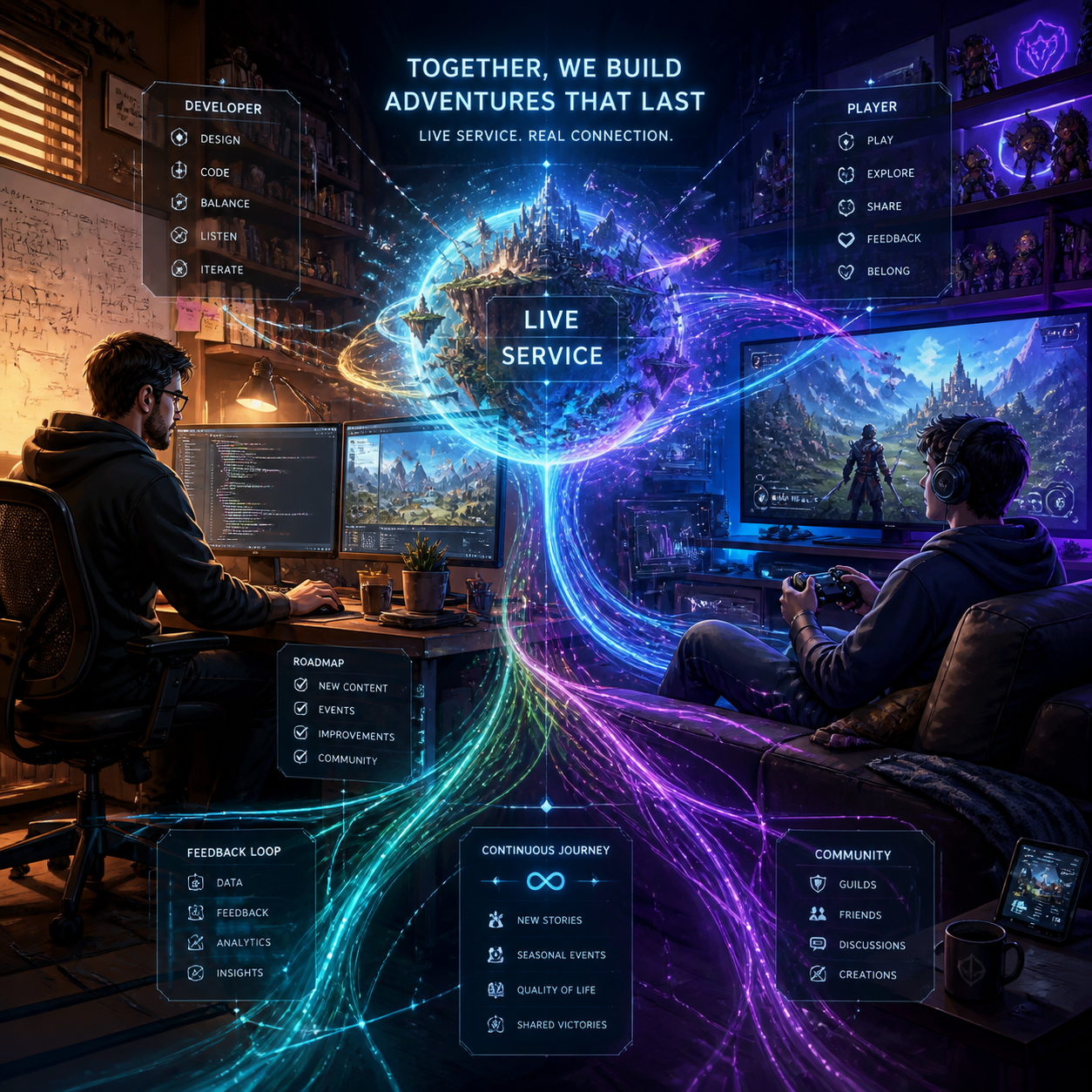
Not long ago, buying a video game meant exactly that: a transaction. You handed over money, received a disc or a download, and that was the end of the exchange. The developer moved on to their next project. You moved on to your next game. The relationship, such as it was, lasted about 60 hours and then dissolved.
Live-service games have dismantled that model entirely. In its place, something far more complicated — and far more interesting — has emerged.
From Boxed Product to Ongoing Service
The shift from traditional games to live-service titles represents one of the most significant structural changes in entertainment history. Instead of a finished product, players now receive a platform — one that evolves, expands, and responds over months or years.
Games-as-a-service (GaaS) titles like battle royales, MMORPGs, and hero shooters operate on a fundamentally different contract with their audience. The game you play today may look almost nothing like the version that launched. Maps get reworked. Characters get rebalanced. Entire storylines unfold across seasonal updates. The product is never truly finished, which means the relationship between player and developer is never truly finished either.
This creates something traditional games never had: ongoing dependency. Players invest time, money, and emotional energy into a game that exists only as long as the studio keeps it running. That dependency changes everything about how both sides behave.
The Feedback Loop: Players as Co-Creators
Live-service models give players a genuine voice in shaping game development — something that simply didn't exist when games shipped as complete, sealed products. Developer teams now track player behavior through usage data, monitor community forums, run surveys, and watch social media sentiment in near real-time.
When a weapon feels overpowered, players say so loudly. When a new map gets poor engagement metrics, developers notice. This creates a feedback loop that can be remarkably responsive. Some studios have reversed major design decisions within weeks of a patch going live, specifically because community response made the problem impossible to ignore.
The more interesting development is how players have started to internalize this influence. Communities form around the idea that their collective voice matters. Dedicated players write detailed balance proposals, create spreadsheets analyzing game mechanics, and organize coordinated feedback campaigns. In some cases, this player-driven game evolution genuinely improves the product. In others, it creates a vocal minority that drowns out the silent majority who are perfectly happy with the game as-is.
Early access and beta testing have extended this dynamic even further. Studios now routinely invite players into development before launch, gathering data and feedback that directly shapes the final product. The line between tester and player has blurred considerably.
Transparency and Trust: When Developers Go Public
Developer transparency has become a competitive advantage in the live-service space. Studios that communicate openly — publishing roadmaps, explaining patch notes in detail, acknowledging mistakes — tend to build stronger communities than those that operate quietly.
This openness is partly strategic. When players understand why a decision was made, they're more likely to accept it even if they disagree. A patch note that says "reduced damage by 15% to improve competitive balance" lands differently than one that offers no explanation at all.
But transparency cuts both ways. When developers commit to a public roadmap and then fail to deliver on schedule, the community notices. Promises made in developer livestreams become receipts. Players screenshot statements and resurface them months later when reality diverges from the plan. Trust, once broken in this environment, is genuinely difficult to rebuild — and the evidence of the breach lives permanently in community archives.
The studios that navigate this best tend to treat their community management teams as genuine communication partners rather than PR filters. There's a meaningful difference between a developer who explains a hard decision honestly and one who issues a corporate statement that says nothing.
Monetization: The Tension at the Heart of the Relationship
Monetization is where the player-developer relationship gets most complicated. Battle passes, seasonal cosmetic stores, and microtransactions fund the ongoing development that keeps live-service games alive — but they also introduce a persistent tension that traditional games never had to manage.
The core friction is one of perception. Players understand, intellectually, that ongoing content costs money to produce. But when a studio releases a cosmetic bundle priced at $20 while simultaneously shipping a patch that many players feel was undercooked, the optics become difficult. The question players start asking isn't "is this cosmetic worth $20?" but "where is our money actually going?"
Season passes have become the dominant monetization structure partly because they offer a clearer value proposition than random loot boxes. Players know what they're getting and can decide whether the content justifies the cost. This relative transparency has made battle passes more broadly accepted than earlier monetization models. Loot boxes, by contrast, generated significant regulatory scrutiny in multiple countries precisely because their probabilistic nature obscured the real cost of desired items.
Choosing a live-service game for its ongoing content means accepting that monetization will always be part of the experience. The question is whether the studio handles it with enough fairness and restraint to keep players feeling respected rather than extracted from.
When the Relationship Breaks Down: Backlash and Burnout
Player frustration in live-service games follows recognizable patterns. Content droughts — extended periods with no meaningful updates — erode player retention faster than almost anything else. When a game goes quiet for weeks, players don't wait patiently; they leave, and bringing them back is significantly harder than keeping them engaged in the first place.
Broken promises generate a different kind of damage. When studios announce features, modes, or content that never materialize — or arrive so changed from the original description that they're barely recognizable — the community's trust takes a hit that patch notes alone can't repair.
Then there's the burnout problem. Player retention strategies built around daily login rewards, time-limited events, and expiring battle pass content create a sense of obligation that can transform a hobby into a chore. When playing a game starts to feel like a job, players don't just quit the game — they often develop lasting negative associations with the studio behind it.
Studios that respond well to backlash tend to do a few things consistently: they acknowledge the problem directly, they explain what went wrong without making excuses, and they follow up with concrete action rather than just words. The studios that struggle tend to respond defensively or stay silent, which the community almost always interprets as confirmation that their concerns don't matter.
Loyalty, Community, and the Long Game
The most successful live-service titles don't just retain players — they build communities that become part of the game's identity. When players have spent hundreds of hours in a shared world, formed friendships through it, and watched it evolve over years, their relationship with that game is genuinely different from anything a traditional title could produce.
This long-term player investment creates a kind of loyalty that's both powerful and fragile. Players who have been with a game since its early days often feel a sense of ownership over its direction. They're the loudest voices in community discussions, the most likely to recruit new players, and the most likely to defend the game to critics. They're also the most likely to feel personally betrayed when the studio makes decisions they see as selling out or abandoning the original vision.
Community management, done well, channels this energy productively. Developer-hosted events, community spotlights, and genuine engagement with fan content all signal that the studio sees its players as partners rather than customers. That signal matters more than most studios seem to realize.
What This Means for the Future of Game Development
The live-service model has permanently raised player expectations for developer engagement, transparency, and responsiveness. A studio that releases a game and goes quiet is now seen as failing its community, not just its product. That expectation isn't going away.
For developers, the sustainability challenge is real. Maintaining a live-service game requires continuous investment in content, community management, and technical infrastructure. Not every studio has the resources to sustain that indefinitely, which is why the industry has seen a wave of live-service shutdowns in recent years — titles that launched with ambition but couldn't maintain the pace the model demands.
For players, the evolving relationship brings genuine benefits alongside real risks. The influence players now have over game development would have seemed remarkable a decade ago. So would the expectation that a game purchased today might be unplayable in three years if the servers go dark.
The player-developer relationship in the live-service era is more collaborative, more emotionally invested, and more volatile than anything that came before. Whether that's a net positive depends heavily on how both sides handle the responsibilities that come with it.
Frequently Asked Questions
What is a live-service game and how does it differ from a traditional game?
A live-service game is an ongoing platform that receives continuous post-launch content updates, balance changes, and new features over an extended period — often years. Traditional games ship as complete products; live-service titles are designed to evolve indefinitely, funded through microtransactions, battle passes, or subscription models rather than a single purchase price.
How do developers use player data to shape game updates?
Studios track a wide range of behavioral data: which modes players spend time in, which characters or weapons they choose, where they drop off in progression systems, and how they respond to new content in the days after a patch. This usage data is combined with community feedback from forums and social platforms to prioritize balance changes and content decisions. The result is a development cycle that's more data-informed than traditional game development ever was.
Can players actually influence the direction of a live-service game?
Yes, though the degree of influence varies significantly by studio. Organized community feedback has reversed balance decisions, prompted feature additions, and even reshaped monetization structures in documented cases. That said, studios ultimately control what ships. Player feedback is one input among many, and commercial priorities, technical constraints, and long-term design vision all factor into final decisions.
What are the risks of live-service games for players?
The primary risks include monetization pressure that can make full enjoyment feel pay-gated, the psychological burden of time-limited content that creates artificial urgency, and the fundamental impermanence of a game that depends on server infrastructure to exist. When a live-service title shuts down, players lose access to everything they invested in — time, money, and community alike.
Why do some live-service games succeed long-term while others shut down?
Long-term success in the live-service space generally comes down to three factors: a strong core gameplay loop that remains engaging across hundreds of hours, a studio willing to invest consistently in content and community management, and monetization that players feel is fair rather than exploitative. Games that fail typically struggle with at least one of these — either the core experience grows stale, the content pipeline runs dry, or the relationship with the player base deteriorates beyond recovery. The video game industry has seen both extremes play out repeatedly over the past decade.