From Text Commands to Epic Worlds: The Evolution of Multiplayer Online Games
Every massive online world you can explore today — every raid boss, guild hall, and player-driven economy — traces its roots back to a blinking cursor on a black screen. The story of multiplayer online games is genuinely one of the most remarkable technological and cultural journeys in entertainment history, and it's still unfolding.
Where It All Began — The World of Text-Based MUDs
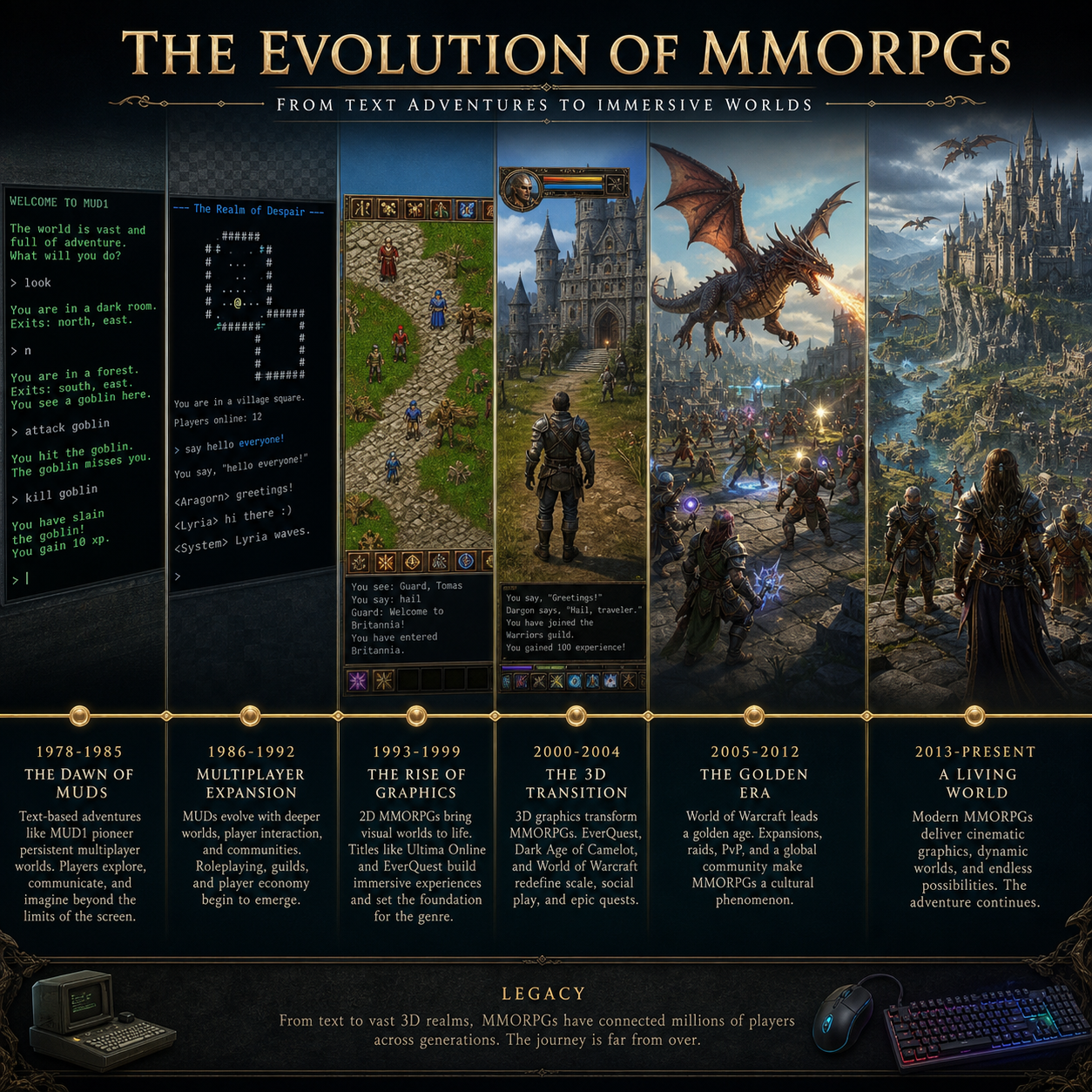
MUDs (Multi-User Dungeons) are the true origin of multiplayer online gaming, first appearing in 1978 when Roy Trubshaw and Richard Bartle created the original MUD at the University of Essex. These were entirely text-based environments where players typed commands like "go north" or "attack goblin" to interact with a shared, persistent world.
What made MUDs genuinely revolutionary wasn't the technology — it was the concept. For the first time, multiple people could inhabit the same virtual space simultaneously, form groups, trade items, and build reputations that persisted after they logged off. The persistent world was born here, long before anyone had graphics to show for it.
Players developed elaborate social hierarchies, formed the earliest versions of guilds, and even created rudimentary virtual economies through item trading. The mechanics were primitive by any modern standard, but the underlying human behavior — cooperation, competition, community — was identical to what you'd find in any MMORPG today. By the mid-1980s, hundreds of MUD variants existed, each with its own rules, lore, and loyal player base.
The Rise of Graphical Online Worlds in the 1990s
The shift from text to visuals in the 1990s made online multiplayer gaming accessible to players who had never typed a command in their lives. The graphical interface removed the single biggest barrier to entry.
Ultima Online, launched in 1997 by Origin Systems, stands as the pivotal early milestone. It translated the MUD formula into a 2D isometric world with genuine visual identity — towns you could see, characters you could customize, and a player-driven economy that emerged organically rather than by design. At its peak, Ultima Online attracted hundreds of thousands of subscribers, a staggering number for the era.
The game also surfaced something designers hadn't fully anticipated: when you give players real agency in a persistent world, they'll do unpredictable things. Player-versus-player conflict, market manipulation, and territorial disputes created emergent drama that no scripted quest could match. These lessons shaped every graphical MMO that followed.
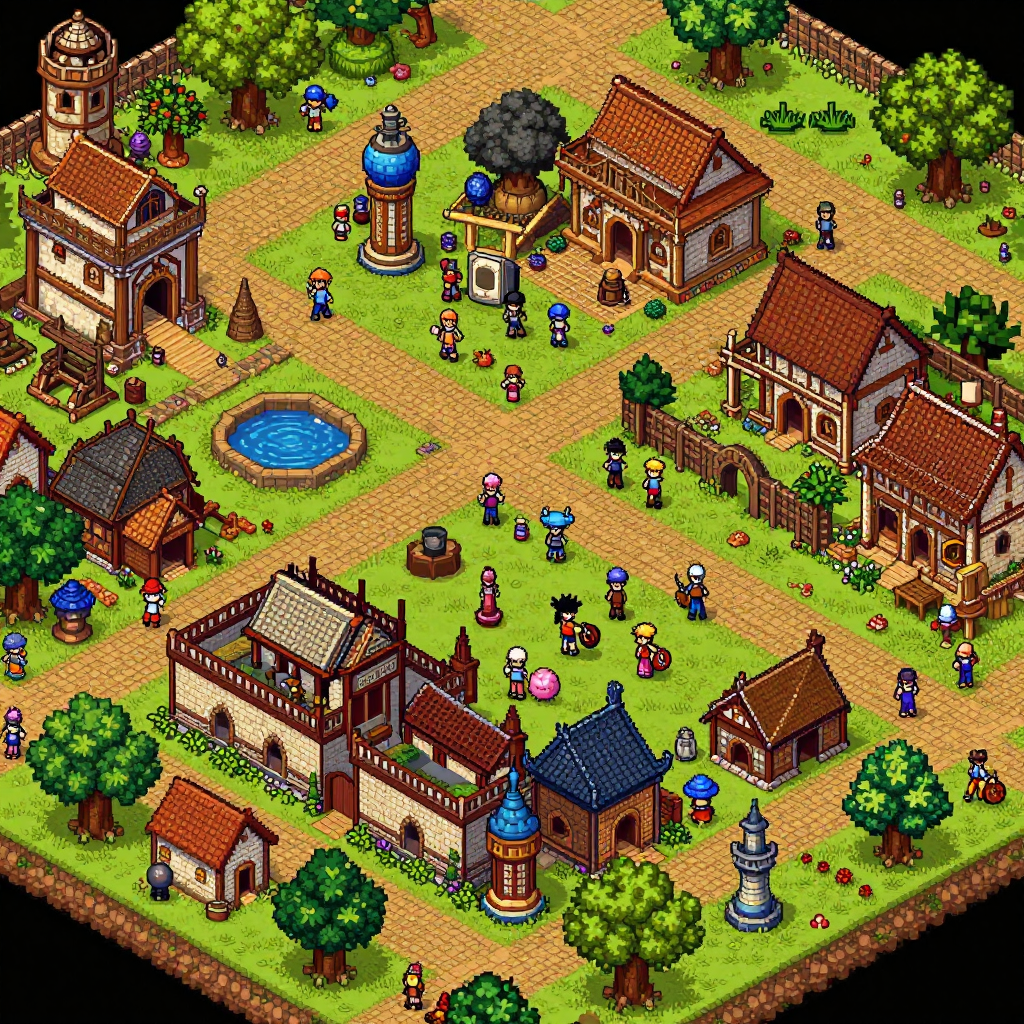
Other titles like Meridian 59 and the text-hybrid Neverwinter Nights (the AOL version from 1991) also contributed to this transitional period, each experiment adding to the collective understanding of what online worlds could be.
EverQuest and the 3D Revolution
EverQuest, released in 1999 by Verant Interactive, was the defining leap into fully immersive 3D environments — and it reset player expectations permanently. Walking through Norrath's forests and dungeons in three dimensions felt like stepping inside a world rather than observing one from above.
EverQuest deepened every system MUDs had pioneered. Character progression became genuinely complex, with dozens of classes, intricate spell systems, and gear that visibly changed your avatar's appearance. Guilds evolved from social labels into operational units that coordinated multi-hour raid attempts requiring precise teamwork from 40 or more players.
The game was also notoriously demanding. Players would spend entire evenings on a single dungeon crawl, often losing hours of progress to a bad death. That difficulty created fierce loyalty — and fierce community bonds. EverQuest players didn't just play the game; they built friendships around it, some of which lasted decades.
By setting the bar for depth, social complexity, and persistent-world design, EverQuest essentially wrote the design blueprint that World of Warcraft would later refine for a mass audience.
World of Warcraft and the Mainstream Moment
World of Warcraft, launched by Blizzard Entertainment in 2004, is the single most significant commercial and cultural moment in MMORPG history. WoW didn't invent the genre — it made it mainstream.
What Blizzard understood that earlier developers hadn't fully solved was friction. EverQuest was deep but punishing. WoW retained the depth — questing, raiding, guild progression, virtual economies — while systematically reducing the barriers that kept casual players from engaging. Death penalties were lighter. Navigation was clearer. The onboarding experience was genuinely thoughtful.
The result was a subscriber base that peaked at around 12 million players, a figure that transformed how the entire games industry viewed online multiplayer. Suddenly, MMORPGs weren't a niche genre for dedicated hobbyists. They were a mainstream entertainment category with cultural weight to match television and film.
WoW also standardized genre conventions that persist today: the structured raid tier system, the auction house as a virtual economy hub, the talent tree for character customization, and the guild as the primary social unit. Most modern MMOs are, in some sense, in conversation with the template WoW established.
Technology as the Engine of Evolution
Each generational leap in multiplayer online gaming was made possible by a corresponding technological shift. The games didn't evolve in isolation — the infrastructure evolved with them.
MUDs ran on university servers and required nothing more than a dial-up connection and a terminal. That was sufficient for text. Graphical worlds like Ultima Online pushed the limits of what dial-up could handle — loading a new zone could take minutes, and lag was a constant companion.
The mass adoption of broadband internet in the early 2000s is arguably the single most important non-game factor in the MMORPG boom. When connection speeds stopped being a bottleneck, developers could build richer worlds, more players could participate simultaneously, and the experience became fluid enough to feel genuinely immersive. EverQuest arrived just as broadband was beginning to spread; WoW launched into a market where it had become common.
Server infrastructure improvements ran in parallel. Handling thousands of concurrent players in a shared persistent world requires substantial backend engineering. As that engineering matured, so did the scale and stability of the worlds developers could create.
What MUDs Left Behind — Design DNA in Modern MMORPGs
The mechanics players take for granted in today's MMORPGs were largely invented in MUDs decades earlier. The lineage is direct and traceable.
Consider the core loop of any modern MMORPG: accept a quest, venture into a dangerous area, defeat enemies, gain experience, level up your character, acquire better gear, and repeat at higher difficulty. Every element of that loop existed in MUDs. The terminology even survived — "quest," "level," "guild," "loot" — these are MUD-era words that never left the vocabulary.
Virtual economies offer an especially clear through-line. MUD players traded items and services through text-based markets. Ultima Online's player economy became famous for its emergent complexity. EverQuest had a thriving secondary market. WoW's auction house became a game within the game. Today, some MMOs feature economies sophisticated enough to attract academic study. The economic behavior didn't change — only the interface did.
The same holds for player communities. MUD guilds were small, tight-knit groups coordinating through text. Modern guild systems in games like Final Fantasy XIV or Guild Wars 2 are technically far more elaborate, but the social function — shared identity, mutual support, collective achievement — is unchanged from what Roy Bartle's players were doing in 1978.
Where Multiplayer Online Games Are Headed Next
The next chapter of multiplayer online gaming is being written by several converging trends, each of which echoes the same pattern: new technology enabling richer, more connected player experiences.
Live-service models have replaced the traditional expansion cycle for many titles. Games like Final Fantasy XIV and Elder Scrolls Online update continuously, keeping persistent worlds genuinely alive rather than static between releases. This mirrors the MUD tradition of worlds that evolved based on player activity and developer responsiveness.
Cross-platform play is dissolving the hardware barriers that once fragmented player communities. When console and PC players can share the same servers, the potential scale of a persistent world grows substantially. That scale matters — community density is what makes a virtual world feel alive.
Emerging technologies including cloud gaming and increasingly capable AI-driven NPC behavior point toward worlds that are more responsive and less scripted. The dream of a truly dynamic persistent world — one that reacts meaningfully to player choices at scale — has been present since the first MUD. The tools to realize it are getting closer.
From a blinking cursor in 1978 to worlds with millions of simultaneous inhabitants, the arc of multiplayer online gaming is a story about what people do when you give them a shared space and a reason to return. The technology keeps changing. The human impulse behind it never has.
Frequently Asked Questions
What was the first multiplayer online game ever made?
The original MUD, created by Roy Trubshaw and Richard Bartle at the University of Essex in 1978, is widely recognized as the first true multiplayer online game. It established the core concepts of shared persistent worlds, character progression, and player interaction that define the genre today. You can read more about its history on Wikipedia's MUD1 article.
How are MUDs different from modern MMORPGs?
MUDs are entirely text-based — players interact through typed commands rather than visual interfaces. Modern MMORPGs use 3D graphics, voice acting, and sophisticated UI systems. However, the underlying mechanics (questing, leveling, guilds, virtual economies) are largely inherited from MUD design.
Why did World of Warcraft become so popular compared to earlier MMOs?
WoW reduced the friction that made earlier MMORPGs intimidating to casual players while preserving the depth that dedicated players wanted. Blizzard also launched into a market where broadband internet had become widely available, removing the connectivity barriers that had limited earlier titles.
Do people still play text-based MUDs today?
Yes. An active community of MUD players and developers still exists. Several classic MUDs remain online, and new ones continue to be developed. The appeal is partly nostalgic, partly the unique kind of imaginative engagement that pure text demands from players.
What makes a game qualify as an MMORPG?
An MMORPG typically requires: a large number of players sharing the same persistent world simultaneously, role-playing elements including character creation and progression, and ongoing online connectivity. The "massively multiplayer" threshold isn't formally defined, but games supporting thousands of concurrent players in a shared environment generally qualify.