A Deep Dive into the Psychology of In-Game Purchases and Microtransactions
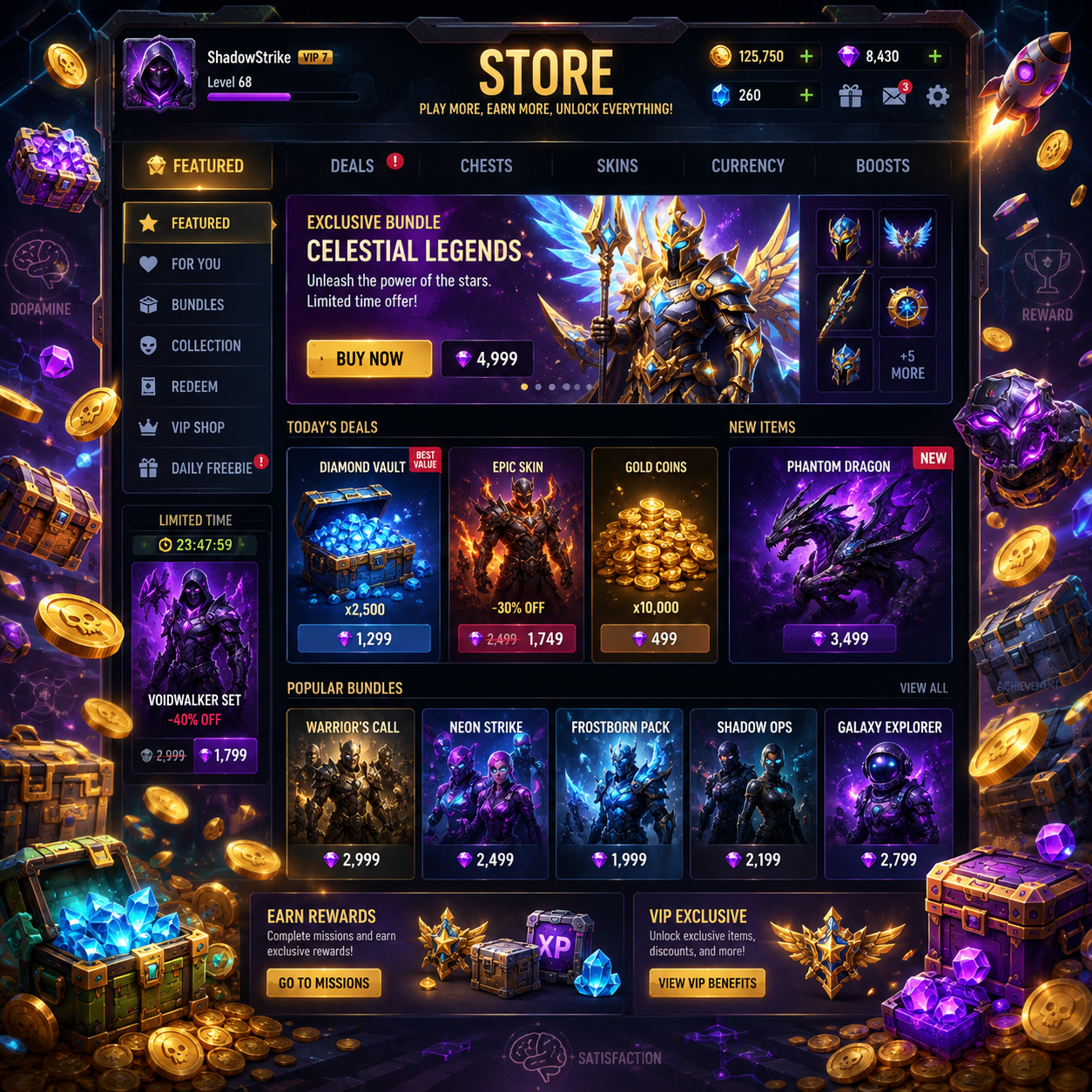
In-game purchases can feel harmless, exciting, and surprisingly easy to justify. A small bundle of virtual currency may unlock a character skin, a loot box, or progress toward a battle pass. Yet the decision often involves more than simple preference. Game interfaces combine reward schedules, social signals, time pressure, and carefully reduced payment friction to influence when and why players spend.
That does not make every microtransaction manipulative, and it does not mean players lack judgment. Optional purchases can support a game, personalize an experience, or provide entertainment. The useful question is more precise: how does a game shape the conditions around a purchase?
Why Virtual Items Feel Valuable
Virtual items feel valuable when games connect them to scarcity, identity, status, personalization, and visible progress. Their value may not exist outside the game, but it can still feel meaningful inside a player’s social and emotional experience.
Scarcity is one powerful ingredient. A cosmetic item described as available for only 24 hours seems more desirable than the same item remaining in a permanent catalogue. Limited availability creates a sense of rarity, even when the publisher can reproduce the item digitally at almost no marginal cost.
Status also matters. A distinctive outfit, emote, weapon effect, or profile badge can communicate experience, taste, achievement, or membership in a particular community. In multiplayer games, other players become an audience. The item gains social meaning because people can see it.
Personalization adds another layer. Players often invest time in choosing a character’s appearance, building a collection, or making a virtual space feel like their own. A cosmetic purchase can therefore feel less like buying pixels and more like decorating a room, choosing clothing, or expressing identity.
Virtual currency changes how the price is perceived. Instead of paying $4.99 for an item, a player may buy 500 gems and spend 450 of them. The extra conversion step separates the purchase from ordinary money. It can also leave a small balance that encourages another transaction later.
The value is genuine as an experience, but it remains contextual. A skin may be worth the price to someone who plays every evening and nearly worthless to someone who will stop playing next week. Asking how often an item will actually be used is a useful reality check.
The Psychological Triggers Behind Spending
Spending triggers work by connecting purchases to emotion, anticipation, social comparison, urgency, and the desire to avoid losing an opportunity. These mechanisms affect ordinary decision-making, especially when the cost appears small.
Rewards create an immediate emotional link. Completing a challenge and receiving a discount, currency bonus, or cosmetic preview can make the store feel like part of the gameplay loop. Instant gratification then shortens the distance between wanting an item and obtaining it.
Anticipation can be even more influential than the reward itself. A preview animation, countdown timer, or opening sequence encourages players to imagine the result before they commit. That mental simulation raises excitement and can make waiting feel uncomfortable.
FOMO, or fear of missing out, appears when a game frames an item as temporary, exclusive, or tied to a current event. Players may buy because they expect regret if the item disappears. The key question is whether the purchase reflects genuine interest or simply anxiety about losing access.
Loss aversion describes the tendency to experience a possible loss more strongly than an equivalent gain. A message such as “Your bonus expires tonight” can feel more urgent than “Receive a bonus today,” even if both statements describe the same offer. The player is responding to the prospect of losing value.
Social influence works through friends, streamers, leaderboards, and visible collections. Seeing others use a new item can normalize spending or create a feeling of falling behind. The effect becomes stronger when purchases confer gameplay advantages or signal belonging.
The sunk cost effect can keep spending going. After investing money or time in a character, collection, or season, a player may feel compelled to spend more to complete it. Previous spending cannot be recovered, however. It should not determine whether the next purchase is worthwhile.
How Game Monetization Systems Shape Player Behavior
Game monetization systems shape behavior by controlling timing, visibility, choice, and payment friction. Loot boxes, bundles, battle passes, progression boosts, and limited-time offers each create different reasons to return to the store.
Loot boxes package an uncertain reward inside a purchase. Bundles provide a clearer exchange, but may include unwanted items or a discount that encourages buying more than intended. Battle passes use a season-long progression track: players pay upfront, then feel motivated to complete enough challenges to justify the purchase.
Progression boosts appeal to impatience. A player may pay to skip a wait, accelerate a level, or obtain resources needed for a competitive mode. This can be convenient in a primarily single-player setting. In a competitive game, the same system may create concerns about fairness or pay-to-win advantages.
Checkout design matters. Saved payment details, one-click confirmation, preselected bundles, and virtual currency packs all reduce the pause in which a player might reconsider. Friction is not always bad; a confirmation screen can prevent accidental purchases. The concern arises when a game makes spending effortless while making prices, cancellation, or purchase history difficult to understand.
Offers also use anchoring. A large bundle may appear beside a smaller one so that the smaller price feels reasonable, even when the player did not plan to buy anything. A discounted item can create a bargain mindset that shifts attention from “Do I want this?” to “How much am I saving?”
These systems do not guarantee spending. They create an environment in which some decisions become more salient, urgent, or emotionally rewarding than others. Player autonomy depends partly on whether the game presents meaningful information before the purchase.
The Role of Variable Rewards and Uncertainty
Variable rewards encourage repeated engagement because the outcome changes from one attempt to the next. Uncertainty creates anticipation, but it also makes spending harder to evaluate when the player cannot know exactly what the purchase will deliver.
A predictable reward gives a clear exchange: pay a stated amount and receive a specific item. A variable reward might provide one of several cosmetics, currencies, or upgrades. The excitement comes from possibility, including the chance of receiving something rare.
This structure can produce a powerful cycle: anticipation before opening, excitement during the reveal, and renewed interest after seeing what might be obtained next. Duplicate items or near-misses may encourage another attempt. A player can begin pursuing a particular outcome even when each purchase only offers a small probability of success.
The important distinction is between uncertainty used for entertainment and uncertainty tied to meaningful financial risk. A free reward earned through normal play carries a different risk from a paid loot box. So does a clearly disclosed purchase with a strict personal limit compared with repeated transactions made under pressure.
Players should check whether a system provides odds, pity mechanics, duplicate protection, or a direct-purchase alternative. These details do not remove every concern, but they make the exchange easier to understand. Authoritative consumer guidance, such as information from the Federal Trade Commission, can also help players and parents think about online purchasing practices.
When Optional Purchases Become Pressure
Optional purchases become pressure when the game uses urgency, obstruction, emotional prompts, or gameplay disadvantages to narrow a player’s practical freedom to decline. The label “optional” alone does not settle whether a monetization system feels fair.
Dark patterns are interface or design choices that steer people toward an outcome they may not have chosen with clear information. Examples include confusing currency conversions, difficult-to-find refusal buttons, repeated prompts after dismissal, hidden recurring charges, and timers that reset whenever a player returns.
Pay-to-win systems raise a separate concern. If purchases provide stronger equipment, faster competitive progression, or exclusive advantages, players may feel forced to spend simply to remain viable. Cosmetic monetization generally creates less direct competitive pressure, although high prices and aggressive FOMO can still affect the experience.
Emotional spending often follows frustration, disappointment, or fatigue. A player loses a match, sees a limited offer, and buys a boost to recover momentum. Younger players and people with limited experience managing money may find virtual currency especially difficult to translate into real cost.
Warning signs include hiding the total price, encouraging repeated low-value purchases, making refusal harder than acceptance, or tying progress to increasingly urgent offers. A healthy system gives players time, clear pricing, and a usable way to play without spending.
How to Make More Intentional In-Game Purchases
To make intentional in-game purchases, convert the price to real money, pause the decision, and judge the item by lasting enjoyment rather than urgency. A short checklist can interrupt the emotional momentum built by a store interface.
- Check the real cost. Convert virtual currency into dollars, pounds, euros, or your local currency. Include the full bundle price, taxes where applicable, and any unused balance.
- Identify the purpose. Is the item cosmetic, convenient, competitive, or required to avoid an artificial bottleneck? The answer changes how you should evaluate its fairness.
- Remove the timer. Ask, “Would I still want this without the limited-time offer?” If the answer is uncertain, wait at least until the next day.
- Compare use with price. Estimate how often you will use the item over the next month. A frequently used cosmetic may provide more value than a rare item that disappears in your inventory.
- Set a budget before playing. A monthly cap works better than deciding during a promotion. Disable saved payment methods if impulse spending is a recurring problem.
- Watch for sunk costs. Money already spent is gone. Decide whether the next purchase makes sense on its own.
Parents can use platform spending limits, purchase passwords, and account-level receipts. Players who repeatedly spend more than intended should involve a trusted person and use stronger account controls. The goal is not guilt; it is creating enough distance to make a deliberate choice.
The Future of Player-Friendly Monetization
Player-friendly monetization combines transparent prices, meaningful optional content, informed consent, and gameplay that remains fair without payment. These standards preserve commercial value while reducing avoidable pressure.
Clear pricing should show the real-money amount beside virtual currency, explain exactly what a bundle contains, and disclose whether an item is temporary. For uncertain rewards, games can display probabilities, provide duplicate protection, and offer a direct route to desired cosmetics.
Meaningful cosmetic content can support a game without turning competition into a spending contest. Battle passes can feel fairer when they provide enough time to complete them, explain progression clearly, and avoid punishing players who miss a week. Their value depends on the player’s schedule; a pass that requires daily commitment may become another source of pressure.
Informed consent also means making the purchase decision understandable. A player should know whether an item changes gameplay, whether content expires, and whether a transaction is one-time or recurring. Good design can still be persuasive through quality and creativity rather than confusion.
Monetization works best when players can answer three questions before paying: What am I receiving? What will it cost in real money? Can I enjoy the game fully without it? If the answers are visible, players retain agency and developers can earn support without relying on hidden urgency.
Frequently Asked Questions
Why are microtransactions so psychologically effective?
Microtransactions combine small apparent prices with rewards, personalization, social influence, instant gratification, and low-friction checkout. Virtual currency can further separate the purchase from its real-money cost.
Are loot boxes the same as gambling?
Loot boxes and gambling share uncertainty and chance, but their legal treatment and psychological impact vary by system and location. The relevant details include whether players pay real money, whether rewards have value outside the game, and whether the game discloses odds.
How can players avoid impulse purchases in games?
Use a preset budget, calculate the real-money price, remove saved payment details, and wait before buying limited-time offers. Ask whether you would want the item without the countdown or social pressure.
What makes an in-game purchase feel fair?
A purchase feels fair when its price and contents are clear, the item provides the advertised value, refusal is easy, and players can continue enjoying core gameplay without paying. Cosmetic items usually create less fairness concern than competitive advantages.
Are battle passes better than other monetization models?
Battle passes can be more predictable than loot boxes because they often show their reward track in advance. They can still create pressure through expiration dates, completion requirements, and fear of wasting the initial payment, so their fairness depends on structure and player schedule.